

Guide for Planting & Care of Bare Root Trees
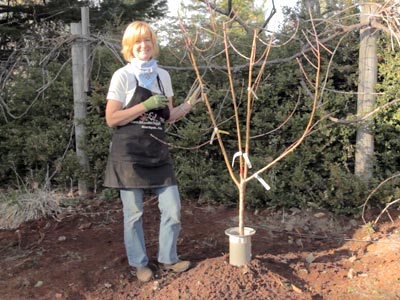
Size of the Planting Hole
Advice for planting bare root fruit trees has changed in recent years. Universities have recently studied root growth in fruit trees. They have a planting technique that expands root growth exponentially, and should be of interest to organic home gardeners and orchardists alike. Prior to planting, make sure you are well-educated on how to care for these young trees to prepare them for success.
Curious?
Our video "How to Plant a Bare Root Tree" explains the concepts in more detail. No more deep holes here, the new method calls for a shallow, saucer-shaped hole that is three times as wide as the tree roots and deep enough to allow planting at the same depth the tree was in the field (note the change in color on the trunk).
These standards have been adopted industry wide, including endorsement by the American Nursery and Landscape Association (ANLA), American Society of Consulting Arborists (ASCA), American Society of Landscape Architects (ASLA), International Society of Arboriculture (ISA), and Tree Care Industry Association (TCIA).
Positioning the Tree in the Hole
The position will depend whether or not it is a single or multi-graft tree. If you are putting in a multi-graft tree, position the smallest graft or scion, to the south facing position. This will assure that the largest scion does not take over the tree. For a single graft bareroot tree be sure and point the graft towards the north or the northeast to prevent sun damage.
Mulching Newly Planted Trees
Arborists warn against mulching around the base of the new tree: With newly planted trees, do NOT place mulch directly over the root ball. Rather, mulch the backfill area and beyond. Never place mulch up against the trunk as this may lead to bark decay. Over the backfill area and beyond, 3-4 inches of wood chip mulch gives better weed control and prevents additional soil compaction from foot traffic.
There's an epidemic of over-mulching trees that some call "volcano mulching"; be sure that doesn't happen in your garden or orchard

Bare Root Tree Season is December – February
If you aren't ready to plant when you receive them, you can heel them in and plant them when the time is right.
To heel in your trees, choose a shady location and dig a trench about a foot deep. If your ground is frozen through winter, you can heel in either in the cellar or in the garage. Place the trees in the trench bundled as closely together as possible leaning against the slope. Cover the roots with loose soil compost or wood shavings, but avoid using rice hulls, cedar or redwood shavings, and it's important not to let the root system dry out or freeze.
You want to keep the roots moist, but not soaking wet, until you are ready to plant. The point of heeling in is to keep the roots moist, protect the tree from freezing and keep it cool enough that it doesn't break dormancy.
If your ground is frozen or if you're under snow you can create this same environment in a wheelbarrow or some other type of container and store it in your basement, garage or cellar. If you see the buds swell and then the tree starts to flower in early spring, it has broken dormancy and it needs to be planted immediately.
Whether you want to try the new planting methods or go with the traditional way, be sure to take advantage of one of the great bargains in food production with our bare root trees for sale. Enjoy growing fruit in your home garden or orchard this year.



2 comments
Tuan, yes you can pot up your bare root tree in a 5-10 gallon pot, moisten the soil, and store in your basement until you are ready to plant. The trees will stay dormant until the temps start going above 45-50F. You don’t have to do much, just don’t let the soil dry out but don’t keep the soil soggy, drain holes in the pots is a good idea.
I bought 2 foot tree I got email of the shipment this week. We still have snow outside and cold so can I plant in the pots in basement basement to march or April