
Welcome to our new website! If you have any questions, please call toll free (888) 784-1722 from 8:30-4:30 Monday-Saturday, Pacific Time.
ladybug
Search Site
   
 
Resources


Find Solutions
Pesky Insect Solutions
Critter & Animal Solutions
Fungus & Disease Solutions
Organic Fertilizer Solutions
Cover Crop Solutions

organic gardening / articles / What is your USDA plant hardiness zone?
What is your USDA plant hardiness zone?
Oct 26, 2011 - Charlotte from Peaceful Valley
   
  What is your USDA plant hardiness zone?
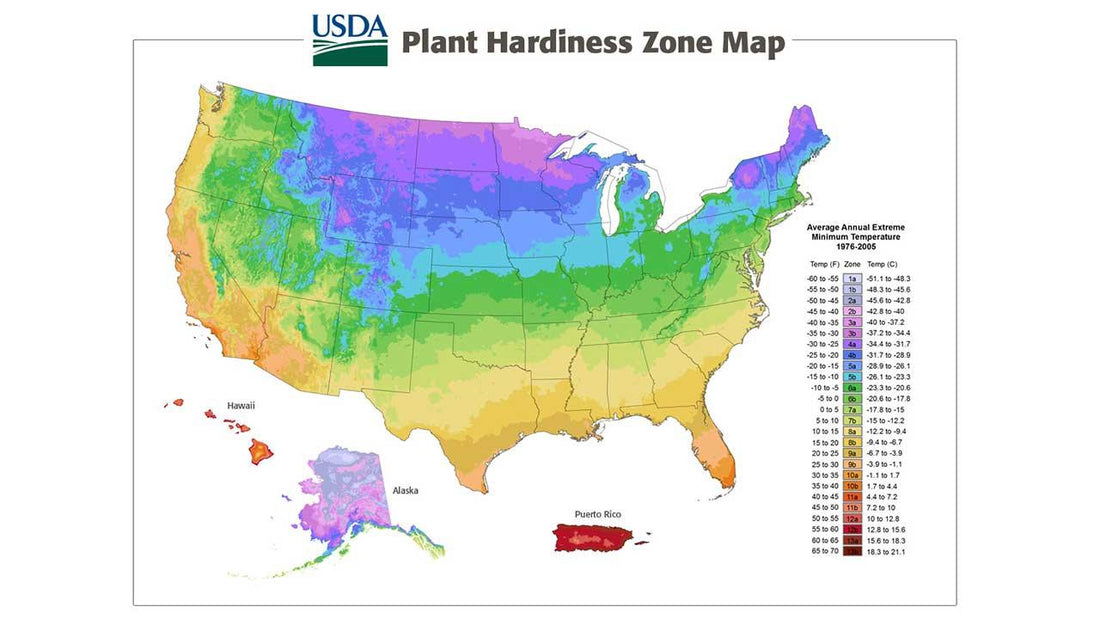
Click the link below to "find yourself". Map courtesy of National Gardening Association.


How can I find my USDA plant hardiness zone?

Find your USDA plant hardiness zone by typing your zipcode in this link. The zipcode tool from the National Gardening Association is easy to use, and simpler than squinting at the USDA map.

Do you live in an area (like Nevada County) with varied terrain and varied USDA zones within one zipcode? Call your local Master Gardeners for expert guidance in establishing the USDA zone for your property.

Here’s a list of the national Master Gardener programs. For Californians, try this list of Master Gardeners by county.

In our new video Tricia explains that knowing your zone is the first step in choosing the right fruit tree for your land. This is true for most of the plants and trees in your garden.

What are plant hardiness zones?

The U.S. Department of Agriculture sorts the whole country into plant hardiness zones. The national map shows gradations of the average minimum temperatures, based on decades of weather records.

For instance, your winter weather might hover around 36F at night, but if cold snaps drop it to 28F the lowest number is the one the USDA factors in. Worst-case scenarios are what they cover.

Why is the weather for zone 7b in California so different from zone 7b in North Carolina?

The USDA zones are only about low temperatures. Other climate differences between California and North Carolina (such as humidity, rainfall during the summer, and highest temperatures) are not considered.


Categories: Berry Plants, Blackberry Plants, Blueberry Bush, Boysenberry Plants, Raspberry Plants, Strawberry Plants, Vegetable Crowns, Artichoke Crowns, Asparagus Crowns, Horseradish Crowns, Rhubarb Crowns, Jerusalem Artichoke, Tree Seedlings, Seed Potatoes, Organic Potato Seed, Fingerling Potato Seed, Seed Garlic, Hardneck Seed Garlic, Softneck Seed Garlic, Elephant Seed Garlic, Organic Seed Garlic, Organic Seed Shallots, Onions, Live Onion Transplants, Onion Sets, Nut Trees, Kiwi Vine, Grape Vines, Wine Grape Vine, Table Grape Vine, Fruit Trees, Apple Trees, Apricot Trees, Plum Trees, Pluot Trees, Cherry Trees, Fig Trees, Peach Trees, Nectarine Trees, Pomegranate Trees, Pear Trees, Persimmon Trees, Citrus Trees, Jujube Trees, Mulberry Trees, Olive Trees, Multi-Graft Trees, Quince Trees, Flower Bulbs, Spring Bulbs, Fall Bulbs, Organic Seeds, Organic Heirloom Seeds, Organic Vegetable Seeds, Organic Herb Seeds, Organic Bulk Seeds, Organic Hybrid Seeds, Organic Cereal Seed, Vegetable Seeds, Vegetable Seeds Organic, Vegetable Seeds Heirloom, Vegetable Seeds Bulk, Tomato Seeds, Hybrid Vegetable Seeds, Biodynamic Seeds, Bulk Seeds, Bulk Organic Seeds, Bulk Vegetable Seeds, Bulk Wildflower Seeds, Bulk Grass Seed, Bulk Herb Seeds, Wheat Seed, Barley Seed, Oat Seed, Rye Seed, Heirloom Seeds, Heirloom Seeds Organic, Heirloom Tomato Seeds, Heirloom Vegetable Seeds, Heirloom Flower Seeds, Flower Seeds, Wildflower Seeds, Heirloom Flower Seeds, Bulk Wildflower Seeds, Perennial Flower Seeds, Annual Flower Seeds, Herb Seeds, Herb Seeds Organic, Bulk Herb Seeds, Medicinal Herb Seeds, Grass Seed, Lawn Seed, Native Grass Seed, Perennial Grass Seed, Ornamental Grass Seed, Fescue Grass Seed, Cover Crop, Green Manure, Annual Cover Crops, Perennial Cover Crops, Erosion Control, Cereal Seeds, Pasture Seed, Dryland Pasture Mixes, Irrigated Pasture Mixes, Seed Garlic, Hardneck Seed Garlic, Softneck Seed Garlic, Elephant Seed Garlic, Organic Seed Garlic, Organic Seed Shallots, Seed Potatoes, Organic Potato Seed, Fingerling Potato Seed, Bulk Potato Seed, Organic Gardening 101


Betty Yuill Says:
Nov 2nd, 2011 at 6:55 am

The zone map is incorrect for my area. I live in Bloomington,CA and it has me as zone 8b…..our temps are never ever down to 15 degreees. We are more like what is zone 10a where Victorville is. But that is incorrect for them also as they are high desert and get snow whereas we don’t. They are probably more like a 9a or 8b. I suppose it varies area by area depending on microclimates. Our zone is classified with the coastal area which is much cooler than we are here. A few miles can make a difference down here with hills to account for. I work in Riverside and watch my temp gauge on my way to work…not long ago there was a 16 degree difference due to Santa Ana condition and the hills that blocked it.

Charlotte from Peaceful Valley Says:
Nov 2nd, 2011 at 10:39 am

Betty, You are so right on the microclimate issue! You said, “I suppose it varies area by area depending on microclimates. Our zone is classified with the coastal area which is much cooler than we are here. A few miles can make a difference down here with hills to account for” and the coast and the hills lead to lots of variations.

Keeping our own garden temperature records helps a great deal, and local Master Gardener groups often have the low temps mapped by topography if your area is not consistent and easy for the USDA to describe with its map.

Reply to this post

Your Name (required) Email, won't be published (required)

Please enter the word you see in the image below:


Articles
The best room and board for your backyard chickens All chickens deserve dry, safe places to live. Offer them good grub too—and you’ll get yummy…
How to solve common problems with water pressure for drip irrigation Problem #1:  How to keep even pressure when water has to run downhill Good news! Gravity is not…

Videos
How to Measure Water Pressure & Flow

Double Digging


Growing Guides
Kiwi Planting & Growing Guide
Grapes Planting & Growing Guide